
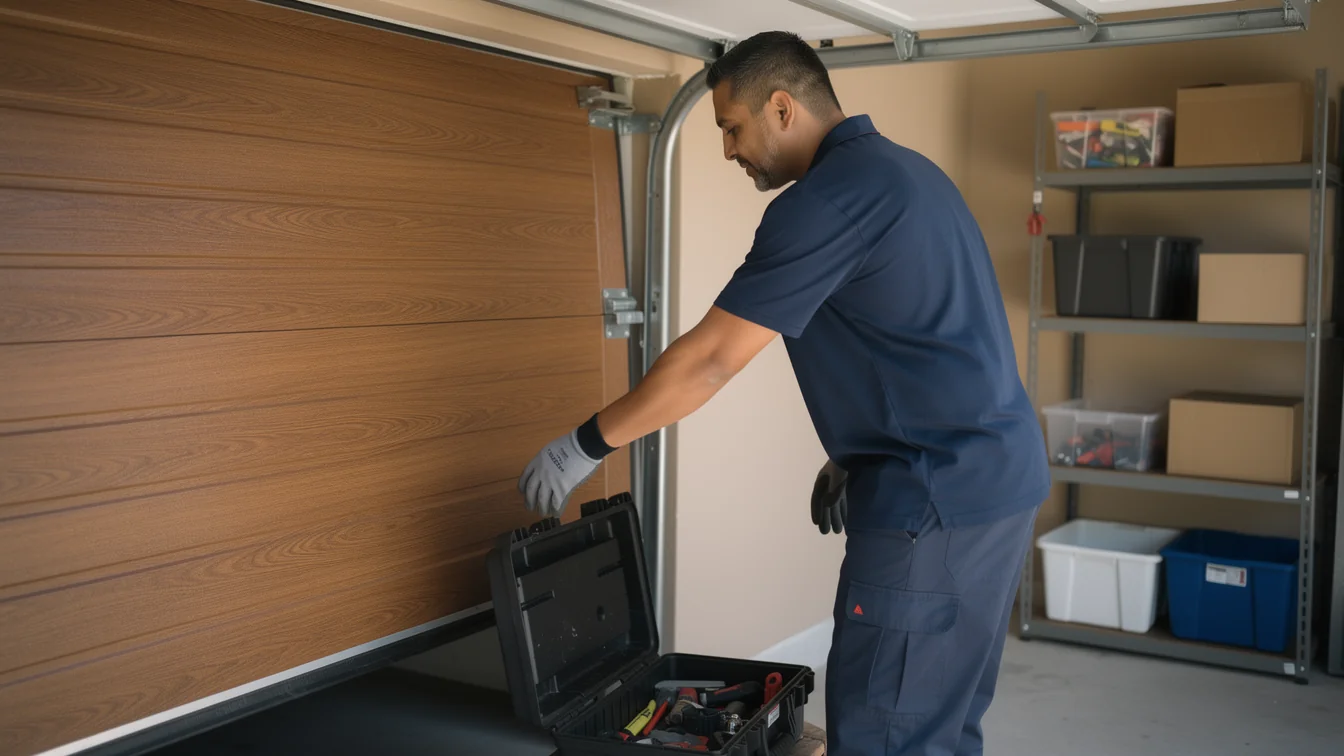
Kingsport, TN · Garage Door Service
What a Garage Door Service Call Actually Covers Here
Kingsport's housing dates mostly to 1970-2001 (median 1978), and our cold-climate checks target the wear points doors of that era hit first on every call.
- Repairs & new doors
- Springs & openers
- Serving 6 nearby communities
What the Weather Here Does to It
Kingsport sits in a cold, moderate climate band, so freeze-thaw cycling is the main driver of spring and cable wear we see. Steel contracts hard overnight in a cold snap, then the sun hits the door face the next afternoon and it expands again. Do that for a few winters and a torsion spring's coil fatigues faster than the maker's rated cycle count would suggest. It's not dramatic - no sudden snap most of the time - it's a slow loosening of the coil tension until one morning the door feels twice as heavy coming up.
Moisture matters as much as temperature. A door that sits wet after an overnight freeze-thaw, then dries under full sun, is what rusts a track or a hinge pin from the inside out before the paint even looks bad. On a service call in this climate band, we're checking for rust at the hinge pivots and track seams before we ever look at the opener, because that's usually the part that fails first.
The honest limit here: a service call checks and adjusts what's there. If the rust has already eaten through a track bracket, we're talking replacement parts, not a tune-up, and that's a different estimate.
The Problem
Across the 15 communities we serve - from Colonial Heights to Central - the typical home was built between 1970 and 2001, with the median landing around 1978. That means most of the garage doors we're called out to aren't original anymore, but the openers and track hardware underneath a lot of them are older than the door itself, because owners replace the door face for looks and leave the working parts in place.
Homes on the Mount Carmel and Gray side of our service area, built mostly in the 1960s and 70s, still run original torsion hardware that nobody stocks new anymore. When a spring on one of those goes, we're often matching wire diameter and coil length by hand rather than pulling a part off a shelf, and that adds time to the call that a newer install wouldn't need.
At a median household income of $63,625, most owners here want a repair that lasts, not a top-shelf replacement they can't justify. That shapes how we quote a job: we'll tell you straight when a spring swap and a track adjustment will get another decade out of a door, and we'll tell you just as straight when the drum or the hardware mount has worn to the point where patching it is money that doesn't hold.
Checking It Yourself
Before you call anyone, there's a handful of things worth looking at yourself, especially given how many doors in this area are running original torsion setups from a 1970s-era build. Pull the manual release and lift the door by hand. If it's balanced, it should stay roughly where you let go of it, waist-high or higher. If it drops on its own, the spring tension is off and that's not a DIY fix - that's a call.
Look at the springs themselves. A torsion spring with a visible gap in the coil, wider than a finger width, has likely already stretched past where it should sit. Cracks anywhere on the coil mean it's near the end, cold weather or not.
Check the rollers and hinges for rust streaking, especially on the side of the house that gets less sun and stays damp longer after a freeze. That's usually where corrosion starts first in this climate.
Listen on a run: grinding at the top means the opener's drive gear is wearing; a loud bang partway up usually means a cable has jumped the drum. Neither is something to keep running through - a jumped cable under tension is a real hazard, not a minor noise.
Season by Season
Winter is when the freeze-thaw cycling we see in this climate band does its worst work - springs losing tension, hinge pins seizing with rust, weatherstripping cracking stiff in the cold and letting wind under the door. That's the season we get the most calls for doors that suddenly feel heavy or won't seat flush at the bottom.
Spring brings the thaw fully through, and with it moisture working into any rust that started over the winter. It's the better time to catch a corroding track bracket before it fails outright, since the damage is visible but the part usually hasn't let go yet.
Summer heat expands steel panels and can tighten up a track that was set a little loose, which sometimes shows up as new binding on a door that ran fine all spring. It's a lighter season for us overall.
Fall is the window to get ahead of it - weatherstripping replaced, hinges lubricated, spring tension checked - before the first hard freeze starts the cycle over. We can't stop the metal from flexing with the seasons; what a fall check does is make sure it's flexing on hardware that's actually sound going into winter.
Frequently asked questions
Why does my garage door feel heavier in the winter?
Cold contracts the steel in the torsion spring's coil, and the repeated freeze-thaw swing common here fatigues that coil faster than a mild climate would. A door that lifts easily in July can feel noticeably heavier by February as spring tension drops. That's a sign the spring needs adjustment or replacement, not something to force through.
My house was built in the 1970s - is the original hardware still in there?
Often, yes, at least partly. A lot of homes in the 1970 to 2001 build range we see across this service area have had the door panel replaced at some point but kept the original track hardware or opener mount. We check age and wear on both separately during a call, since they don't always match.
Do you replace rusted track brackets on the spot?
If the bracket is accessible and we're carrying stock that fits, yes. If the rust has eaten into a less common mount size, which turns up more on the older original hardware in this area, we sometimes have to order the part, and that call becomes a return visit rather than a same-day fix.
What's included in a standard service call?
A service call covers inspecting the spring, cables, rollers, hinges, and track alignment, checking door balance, and testing the opener's force and travel settings. It does not automatically include parts - if something needs replacing, like a cracked spring or a rusted bracket, that's quoted separately once we've seen it.
Related garage door services in Kingsport
More garage door guides
Book garage door service in Kingsport
Call now or request a quote - tell us what the door is doing and where you are.